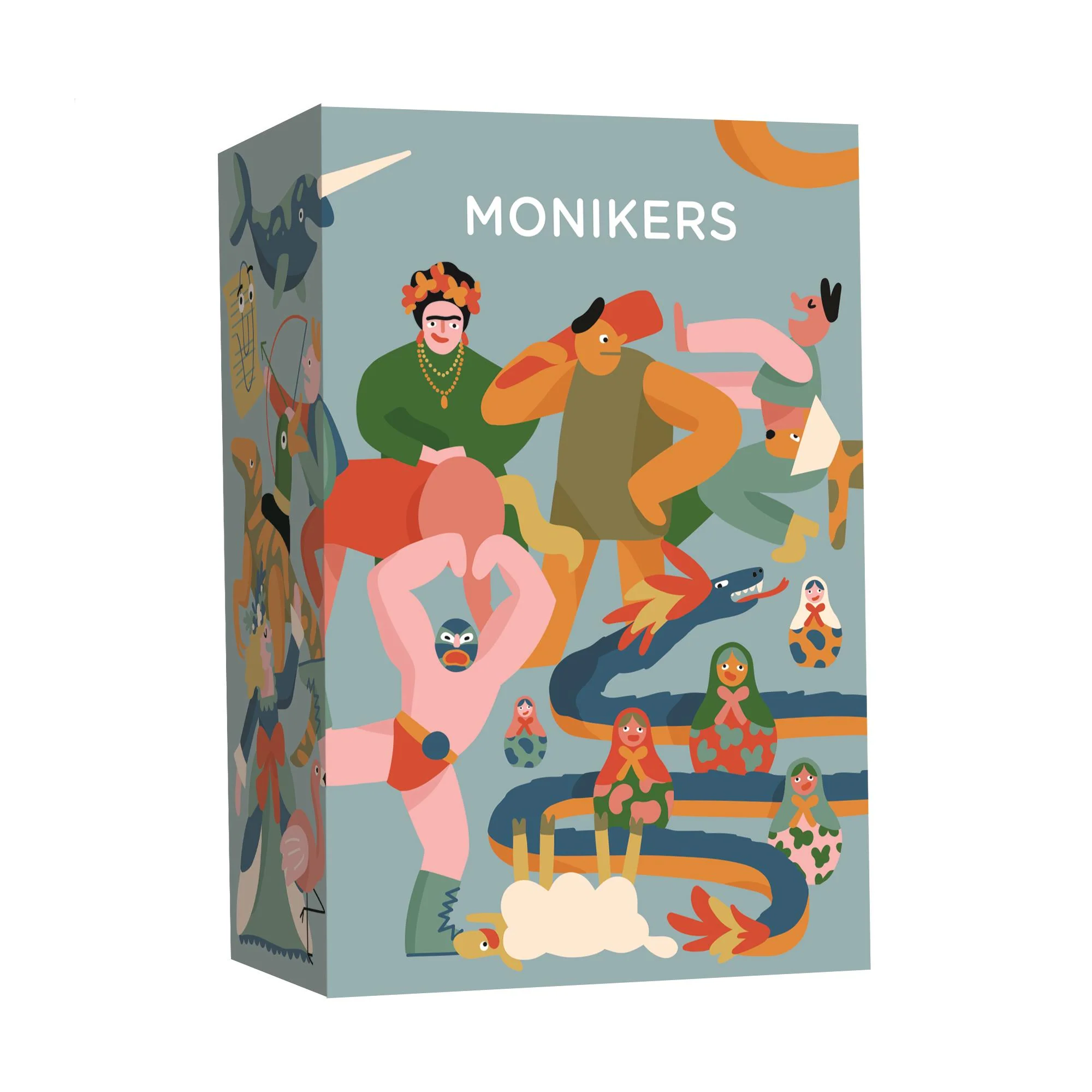
Monikers • 2015
A party game played over three rounds with the same set of name cards. In round one, you can say anything you want to get your team to guess the name (like Taboo without restrictions). In round two, you can only say one word. In round three, you can only act it out silently. The key mechanic: you use the same cards all three rounds. So by round three, your team has heard every name at least once. The game shifts from "describe a thing you might not know" to "act out a shared inside joke that only exists because of the last 15 minutes". Round three is where the game peaks. Someone mimes three seconds of something incomprehensible, and their team yells the answer instantly because of a joke from round one. The table is in hysterics. It works because the group has built a private vocabulary over the course of the game. Before playing, everyone drafts the card pool. Each player gets dealt cards and keeps the ones they like, discarding the rest. This means nobody gets stuck with a name they've never heard of — which is a small design choice that fixes a major problem with similar games. Plays 4-16+ in teams. The more people, the louder it gets. There's no upper limit if you're happy splitting into larger teams. It works well as an evening centrepiece — games run 30-45 minutes and usually get an immediate "again".
Board Game Specialists & Group Dynamics Researchers
Tested and evaluated across real group game nights. We specialize in group playability, player count scaling, rule clarity, and downtime reduction for gatherings of 2 to 12+ players.
Explore our group game finder, strategy guides, and game reviews.
Answer a few quick questions and get a direct recommendation.
Find the right gameGames with similar group dynamics, time commitment, and player counts.
Most board games quietly fall apart above 4 players. Turns drag, half the table checks out, and someone ends up on their phone. These are the ones that actually hold up at 6, 7, and 8 — games where more people means more energy, not more waiting.
Party games fall apart when the rules explanation takes longer than the first round. These don't. You can teach any of them in under two minutes, and most groups are laughing before the first round is over.
Double-digit groups are a different problem entirely. Most games that claim to play 10 actually drag miserably at that count. These games are built for crowds — either through simultaneous play, physical movement, or mechanics that genuinely improve with more people.
When a dozen or more people show up for game night, standard turn orders collapse into chaos. Here's how to host double-digit groups without splitting the room.
Most games break at 10. These are the ones built for it — or clever enough to handle it without slowing down.
Nine players is an awkward count that most games don't support. Here are the ones that actually handle it without falling apart.
Eight players is the breakdown point for most board games. Here are the top games designed specifically for 8 people without turn-wait misery.
You have seven people sitting around your table. Three of them love strategy, four think board games take four hours. Here are ten games that keep everyone engaged without rulebook headaches.