USAopoly • 2009
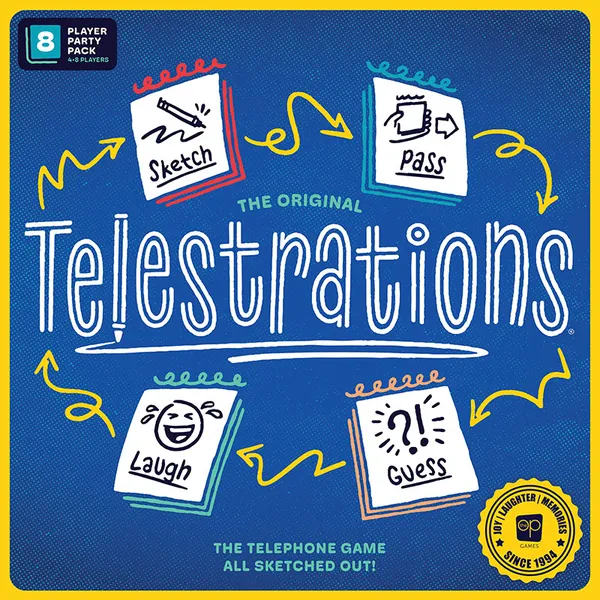
Think of the game Telephone, but with drawing. Each player starts with a word or phrase. You sketch it in a flip book, pass it on, and the next person guesses what you drew. Then the next person draws that guess. And so on around the table. By the time your book comes back to you, the original word has usually been mangled beyond recognition. "Birthday Cake" became "Hat" became "Sombrero" became "Mexico" became... a stick figure next to a cactus. Then everyone flips through and laughs at where it went wrong. There's no real scoring. The game is the reveal. You're not trying to draw well — you're just trying to be understood. Bad artists actually make the game funnier because their drawings are the ones that derail the chain. It works with 4-8 players (the bigger box does 12). The sweet spot is 6-8, where chains are long enough for proper drift. Each round takes about 5-10 minutes, and most groups play 2-3 rounds before moving on to something else. It's one of the few games that genuinely works with any age and any experience level. Kids, grandparents, people who hate board games — everyone can participate and everyone laughs.
Board Game Specialists & Group Dynamics Researchers
Tested and evaluated across real group game nights. We specialize in group playability, player count scaling, rule clarity, and downtime reduction for gatherings of 2 to 12+ players.
Explore our group game finder, strategy guides, and game reviews.
Answer a few quick questions and get a direct recommendation.
Find the right gameGames with similar group dynamics, time commitment, and player counts.
Most board games quietly fall apart above 4 players. Turns drag, half the table checks out, and someone ends up on their phone. These are the ones that actually hold up at 6, 7, and 8 — games where more people means more energy, not more waiting.
Party games fall apart when the rules explanation takes longer than the first round. These don't. You can teach any of them in under two minutes, and most groups are laughing before the first round is over.
Work game nights are tricky. Half the group thinks they hate board games. Someone's too competitive. Someone's too shy. You need games that don't put anyone on the spot, don't require a 10-minute rules explanation, and let people ease in at their own pace.
First time playing with this group? Half the people don't know each other? You need games that create conversation without forcing it, where being wrong is funny instead of embarrassing, and where nobody feels like they're being tested.
Christmas game nights include grandparents, kids, competitive uncles, and people who think board games are boring. These are the games that survive that combination.
Large groups need different games from regular game nights. Here's what actually works when you have 6 or more people and why most popular games quietly fail at this count.
Eight players is the breakdown point for most board games. Here are the top games designed specifically for 8 people without turn-wait misery.
Starting with the wrong game ruins board gaming for new players. Here's what actually works when half your group has never played a modern board game before.
A family reunion game night needs to work across three generations, zero shared gaming experience, and wildly different tolerances for competition. Here's what survives the room.
Every group has someone who backs away the second a cardboard box appears. These games don’t look like board games, don’t need rules explanations, and pull in everyone at the table.
Corporate icebreakers are usually awkward. These team-building board games scale to large groups, protect introverts, and require zero prior gaming experience.
You have seven people sitting around your table. Three of them love strategy, four think board games take four hours. Here are ten games that keep everyone engaged without rulebook headaches.