
Codenames vs Decrypto
Grid Word Association vs. Intercepting Encrypted Word Codes
Codenames
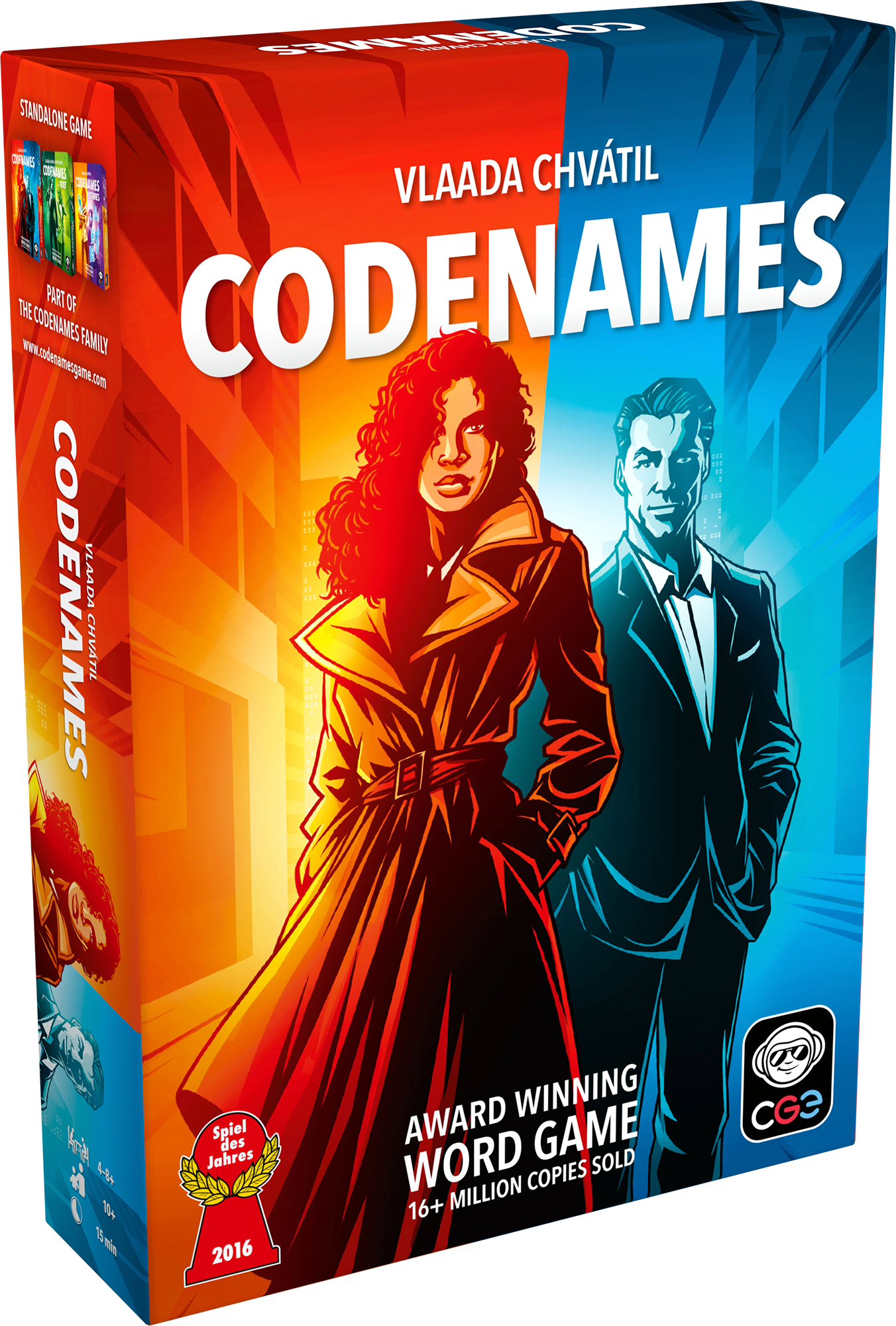
Two teams, each with a spymaster. The spymasters look at a key card showing which words on a 5×5 grid belong to their team. Then they give one-word clues followed by a number — like "Ocean, 3" — hoping their team picks the right three words. Pick a wrong word and you might hand a point to the other team. Pick the assassin word and your team loses immediately. The clue-giving is where the game lives: you're trying to find connections between your team's words that won't accidentally link to your opponents'. It works at any count from 4 to 8, and uneven teams are fine. Turns are fast because guessing is a group conversation, not a solo decision. The spymaster sits in agonised silence while their team debates whether "Ocean" means "Wave", "Blue", or "Fish". It's been around since 2015 and is still the default recommendation for a reason — the rules take 2 minutes, games last 15-20 minutes, and a good clue makes you feel like a genius. There's also a Pictures version and a Duet co-op variant if the original gets stale.
Decrypto
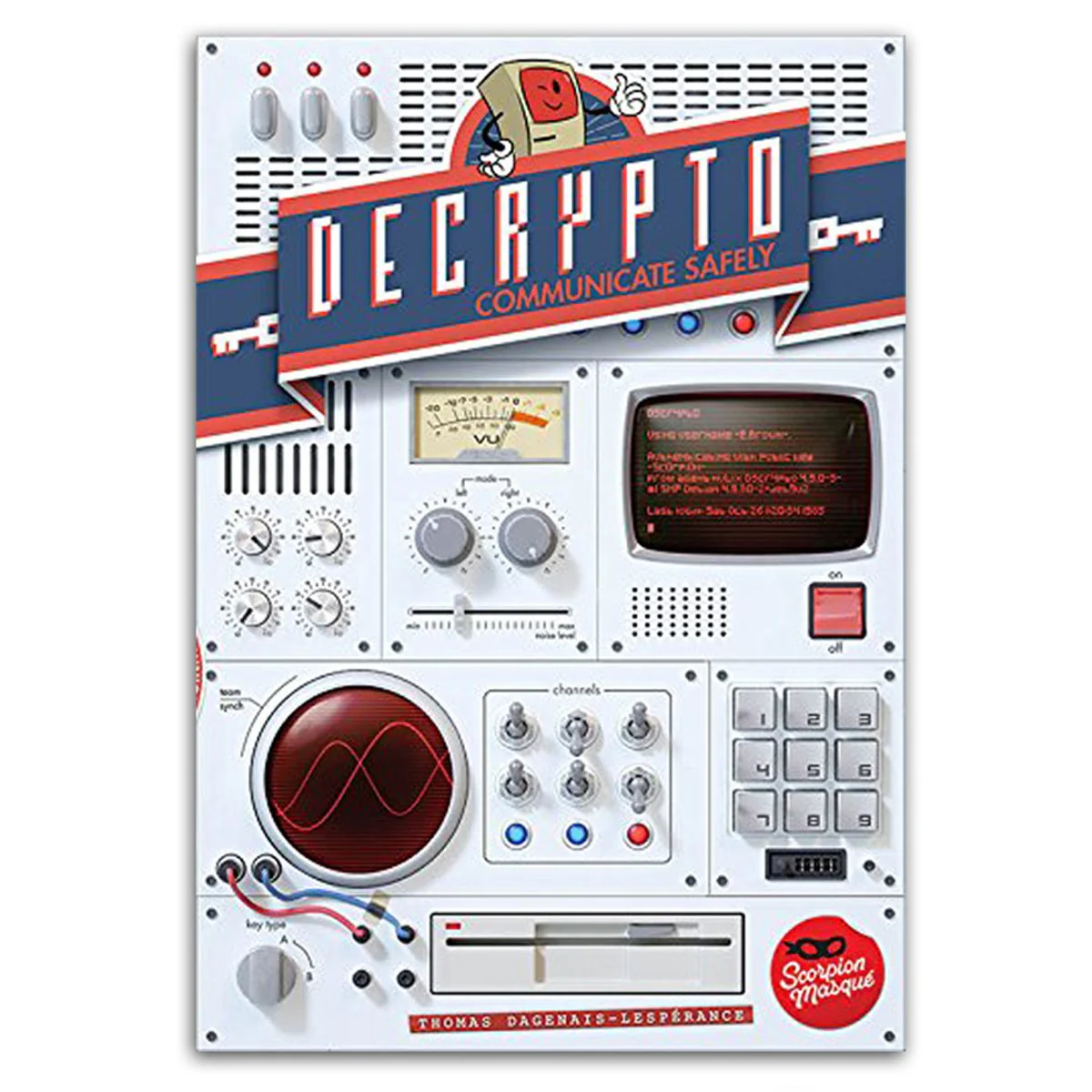
Two teams, each with a screen hiding four keywords. Every round, the clue-giver on each team draws a three-digit code — say, 3-1-4 — and gives three clues, one for each keyword in that order. Your team guesses which keywords correspond to which numbers. Here's the catch: the other team hears your clues too. Over multiple rounds, they build up a picture of which clues map to which keyword slot. If they intercept your code correctly twice, you lose. If your own team fails to decode your clues twice, you also lose. This creates an escalating tension. Early clues can be obvious because the other team has no data. But by round four or five, you need to find fresh angles on the same keywords because the opponents are narrowing in. Where Codenames is about breadth (linking multiple words with one clue), Decrypto is about depth (finding many different clues for the same word over time). A keyword like "Tiger" might get clued as "Stripes" in round one, "Jungle" in round two, "Frosted" in round three (the cereal), and "Eye" in round four (the song). Each new clue risks giving the opponents another data point. It's mechanically tighter and more strategic than Codenames, but also harder to teach. New players often struggle with the interception concept. Once it clicks, though, it creates a competitive word game with more lasting depth. Plays 4-8 in two teams. Sweet spot is 6 (3v3). Games run 30-45 minutes. The 2018 version (with the red and blue screens) is the standard edition. There's also a laser variant with image-based clues.
Head-to-Head Specification Matrix
Direct breakdown of player counts, complexity, and mechanics.
| Metric | Codenames | Decrypto |
|---|---|---|
| Rating | — / 10 | — / 10 |
| Complexity Weight | 1.4 / 5.0 | 1.8 / 5.0 |
| Player Range | 2–8 players | 3–8 players |
| Play Time | 15–30 minutes | 30-45 minutes |
| Primary Categories | Party, Word Game | Word Game, Strategy, Teams |
| Mechanics | Team Play, Clue Giving, Grid Deduction | Team Play, Code Giving, Interception, Deduction |
| Publisher | Czech Games Edition | Le Scorpion Masqué |
| Year Published | 2015 | 2018 |
The Verdict: Which Should You Buy?
Codenames and Decrypto are the twin kings of competitive word association party games. In Codenames, spymasters give single-word clues with a number (e.g., 'Animal 3') to help their team pinpoint words on a 5x5 grid while dodging the instant-death assassin. In Decrypto, both teams hold secret 4-word code keys and transmit 3-digit number sequences (e.g., 'Apple - Beach - Moon') using clues so that their teammates understand while the opposing team scrambles to intercept the patterns. Choose Codenames for casual crowds and quick laughs; choose Decrypto for brainier, endlessly replayable deduction.
Anyone can grasp the grid and the tension of avoiding the assassin word immediately.
Both teams play simultaneously every round, trying to crack the other team's evolving 4-word vocabulary.
Key Differences Explained
DowntimeFactor #1
Elimination RiskFactor #2
Optimal Player CountFactor #3
Rules CurveFactor #4
Pros & Cons Comparison
Codenames
- +Almost everyone already knows how to play, or picks it up in a minute.
- +Good spymasters make it feel like a completely different game. Replayability is huge.
- +Handles uneven team sizes without breaking.
- −Bad spymasters can kill the energy fast. Long pauses while they overthink.
- −Once you've played a lot, the word grid starts feeling samey unless you mix in themed packs.
Decrypto
- +Deeper than Codenames. Each round builds on previous ones, so it rewards paying attention.
- +The interception mechanic is tense. You're trying to crack the other team's code live.
- +Works well at 4 (2v2) and scales fine to 8.
- −Harder to teach than Codenames. The 'code' concept trips people up initially.
- −The game can feel slow with overthinking clue-givers. Set a timer if needed.
Reviewed by TableTop Trends Editorial Team
Board Game Specialists & Group Dynamics Researchers
Tested and evaluated across real group game nights. We specialize in group playability, player count scaling, rule clarity, and downtime reduction for gatherings of 2 to 12+ players.
Frequently Asked Questions
Which is easier to learn: Codenames or Decrypto?
Codenames has a lower complexity rating (1.4/5) compared to Decrypto (1.8/5), making it faster to teach and easier for beginners.
Can you play Codenames and Decrypto with 2 players?
Codenames supports 2–8 players, while Decrypto supports 3–8 players. Both games offer distinct experiences at 2 players depending on how direct or interactive you prefer the gameplay to be.
Which game plays faster?
Codenames typically plays in 15–30 minutes, while Decrypto averages 30-45 minutes.
Looking for Board Games & Game Night Recommendations?
Explore our group game finder, strategy guides, and game reviews.
Curated Collections Featuring These Games
Best Board Games for 6–8 Players
Most board games quietly fall apart above 4 players. Turns drag, half the table checks out, and someone ends up on their phone. These are the ones that actually hold up at 6, 7, and 8 — games where more people means more energy, not more waiting.
Board Games for Work Team Events and Offsites
Work game nights are tricky. Half the group thinks they hate board games. Someone's too competitive. Someone's too shy. You need games that don't put anyone on the spot, don't require a 10-minute rules explanation, and let people ease in at their own pace.
Best Games for Serious Game Nights
Your group has played Codenames enough. These are games where decisions matter, bluffs have consequences, and paying attention is rewarded. Heavier and more demanding than party games, and more satisfying because of it.