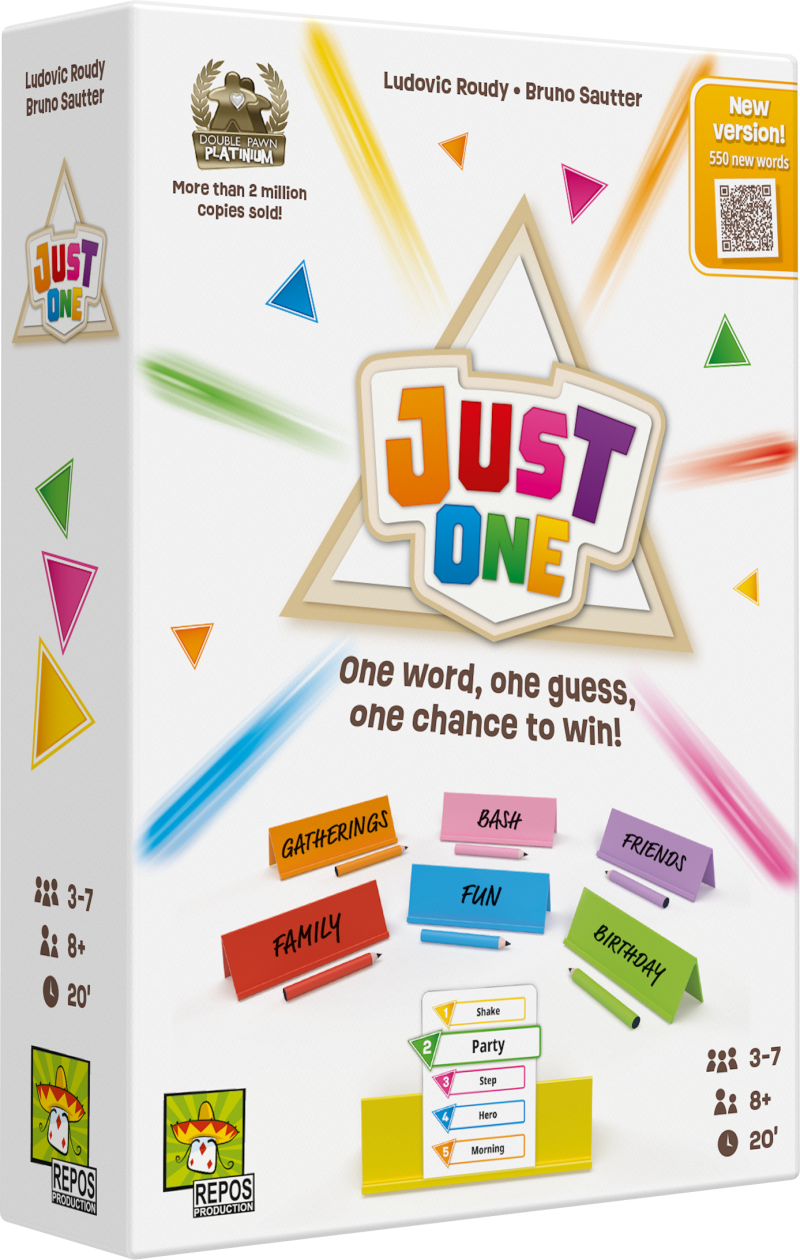
Repos Production • 2018
One player closes their eyes. A word card goes up — say, "Pyramid". Everyone else secretly writes a one-word clue to help the guesser. Before the guesser opens their eyes, you compare clues. Any duplicates get removed. So if three people wrote "Egypt", all three get cancelled. The guesser only sees the remaining clues. Maybe they're left with "Pharaoh" and "Triangle" and that's enough. Maybe everyone wrote the same thing and they get nothing. That's the whole game. No scoring track, no special powers, no complicated rules. You play 13 cards and count how many the guesser got right. The fun is in the duplicate-cancelling. You want to be helpful, but you also don't want to write the obvious clue that everyone else will write. It creates this tension where you're trying to outthink your own teammates — not to beat them, but to help them differently than everyone else. Works best with 5-7 players. Fewer than that and duplicates rarely happen, which removes the interesting part. It's a Spiel des Jahres winner and probably the single lowest-friction game you can bring to any social gathering.
Board Game Specialists & Group Dynamics Researchers
Tested and evaluated across real group game nights. We specialize in group playability, player count scaling, rule clarity, and downtime reduction for gatherings of 2 to 12+ players.
Explore our group game finder, strategy guides, and game reviews.
Answer a few quick questions and get a direct recommendation.
Find the right gameGames with similar group dynamics, time commitment, and player counts.
Getting knocked out ten minutes into a two-hour game while your friends keep playing is miserable. These games eliminate early knockouts entirely so everyone stays in until the final score is tallied.
Christmas game nights include grandparents, kids, competitive uncles, and people who think board games are boring. These are the games that survive that combination.
If your group has played Codenames enough times that the word grid feels familiar, here are the games that scratch the same itch with a different twist.
Large groups need different games from regular game nights. Here's what actually works when you have 6 or more people and why most popular games quietly fail at this count.
Cooperative games have a scaling problem: most max out at 4 players and get chaotic above that. Here are the ones that hold up when your whole group is on the same team.
Starting with the wrong game ruins board gaming for new players. Here's what actually works when half your group has never played a modern board game before.
A family reunion game night needs to work across three generations, zero shared gaming experience, and wildly different tolerances for competition. Here's what survives the room.
Waiting for dinner, between heavier games, or just looking to fill 15 minutes with a big group. These games are designed for exactly this situation.
Sometimes you don't know if 4 people are showing up or 14. These games handle the uncertainty because they were designed to ignore player limits entirely.
Fast, high-energy games for 6 to 12+ players that wrap up in under 30 minutes. Perfect for starting the night or playing while dinner is cooking.
Every group has someone who backs away the second a cardboard box appears. These games don’t look like board games, don’t need rules explanations, and pull in everyone at the table.
Corporate icebreakers are usually awkward. These team-building board games scale to large groups, protect introverts, and require zero prior gaming experience.
You have seven people sitting around your table. Three of them love strategy, four think board games take four hours. Here are ten games that keep everyone engaged without rulebook headaches.